
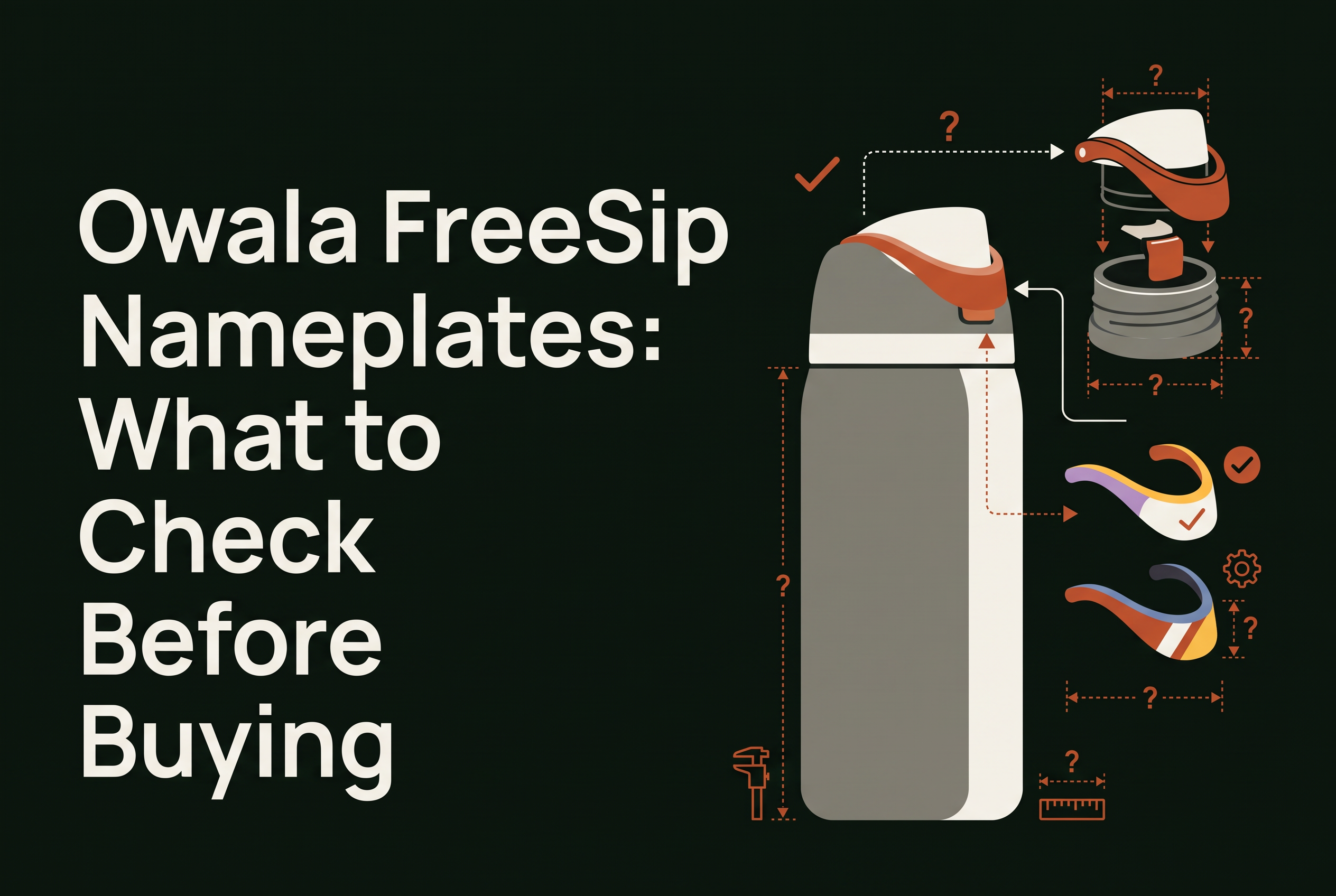
Before you buy an Owala FreeSip nameplate, confirm four things in the listing: the lid style it fits, the bottle sizes it names, how it attaches, and how you are told to wash it. Skip any one of those and you can end up with a plate that sits wrong, peels off, or was never meant for your bottle.
Nameplates are small, cheap and easy to over-trust. A photo of a plate on a bottle tells you almost nothing about whether it fits yours. The listing text does, if you know which lines to read. This guide covers what makers actually state in their listings and what Owala itself publishes about lid styles, so you can read a listing the right way and avoid a wasted order.
What an Owala FreeSip nameplate is (and what it isn't)
An Owala FreeSip nameplate is an aftermarket plate, usually personalized with a name, that you attach to the lid of a FreeSip bottle so you can tell it apart from identical ones at school, the gym or the office.
The key word is aftermarket. In the listings we reviewed, nameplates are sold by independent makers, with Etsy-style shops the most common. They are described as made for authentic Owala FreeSip lids, and they attach with adhesive dots or tape rather than a built-in clip. It's a stick-on accessory, not a part of the lid.
It isn't a swap-in lid either. If you need a new lid, Owala sells those separately on its replacement lids page, where the FreeSip style is its own selectable option. A nameplate decorates the lid you already own.
Check the lid style first: FreeSip, FreeSip Sway, Tumbler and others
Start with the lid style, because it decides whether a plate can work at all, and the most common miss is the FreeSip Sway.
Owala treats its lids as distinct styles. Its replacement lids page lists FreeSip separately from Flip, SmoothSip Slider, Sway and Tumbler lids. Nameplate makers draw the same line. The listings we saw describe plates for authentic FreeSip lids, and some say outright that they are not for the FreeSip Sway. A few also describe plates designed to sit in the groove of the lid, which is a shape-specific claim.
So do this before anything else:
Identify your lid. If you are unsure whether you own a standard FreeSip, a Sway or a Tumbler, check how the lid is listed on Owala's site.
Read the exclusion line. A listing that says "not for FreeSip Sway" means exactly that. Don't assume it will be close enough.
Be wary of vague titles. "Owala name plate" with no lid style named is a flag. Ask the seller which lid it was made for.
If your bottle is a Sway or a Tumbler, a plate made for the standard FreeSip lid is the wrong product, however nice it looks.
Check the size claims: 16, 24, 32 and 40 oz listings
Read the size line as a statement of what the maker says it fits, and match your bottle's capacity to it word for word.
The listings we saw advertise fit for authentic FreeSip lids in 24, 32 and 40 oz, and some also include 16 oz. Those are the makers' claims, not Owala's. Owala does not publish nameplate compatibility, so the maker's listing is the only fit statement you get. Treat it as the seller's word.
A few practical habits:
Look for your exact size. If you own a 16 oz bottle, a listing that names only 24, 32 and 40 oz has not told you it fits.
Remember the lid is the fit point, not the ounces. Owala's own guidance for replacement lids is to choose by bottle style, not just ounces. The same logic applies here: size matters, but only inside the right lid style.
Ask for a measurement or a photo on your size if the listing is thin. A seller who has made plates for your capacity can usually confirm in a sentence.
A size list in the title is a good sign. A size list you have to guess at is not.
Adhesive, removal and washing: what makers say about dots, tape and hand-washing
Expect an adhesive plate that you can remove, and expect to be told to wash the bottle by hand.
The listings we reviewed describe attachment with adhesive circles or dots, in at least one case a set of pressure-sensitive dual-lock adhesive circles. They describe the adhesive as removable rather than permanent, which has two consequences. You can take the plate off, and you may need to replace the adhesive over time.
On cleaning, the same listings state the nameplate is hand-wash only and not dishwasher safe, and they advise against running it through the dishwasher. If you put your bottle in the dishwasher every night, that instruction matters more than the design.
This is also where the sticker versus 3D-printed question lands. The thing to read is the attachment method and the care line, not how the plate was made. Whatever it's made of, ask three questions: what holds it on, can it come off cleanly, and what does the maker say about washing?
A routine that fits what makers state: remove the plate or work around it when you wash, and keep spare adhesive circles on hand if the listing offers them.
Material and personalization: printed, laser-cut or 3D-printed plates, and how to read Etsy-style listings
Treat the material as secondary to fit, and read an Etsy-style listing from the title down to the variation menu.
Plates in this category are typically described as custom, with the buyer supplying a name, and they can be made by printing, laser cutting or 3D printing depending on the shop. We have not seen a source that ranks one method as better for durability, so don't pay extra on that assumption. Judge the plate by the listing's stated fit, attachment and care instructions instead.
Here is how to read a listing in order:
Title: lid style and sizes named? "FreeSip" plus a size list is what you want.
Description: look for the Sway exclusion, the adhesive type and the hand-wash line. If all three are present, the seller has thought about it.
Personalization box: check character limits, font options and whether you can see a proof before it ships.
Photos: look for a plate on a lid like yours, not only a flat render.
Reviews: scan for mentions of fit and adhesive, not just the design. A review that says it stayed on after weeks of use tells you more than "cute."
If a listing leaves out the lid style, the sizes or the care line, message the seller before you order.
Pre-purchase checklist and questions to ask the seller
Run every listing through the same short list, and send the seller a message for anything it leaves unanswered.
Checklist:
My lid is a standard FreeSip, not a Sway or Tumbler.
The listing names my bottle size (16, 24, 32 or 40 oz).
The listing says it is for authentic Owala FreeSip lids.
The attachment method is stated (adhesive dots, tape or groove fit).
The adhesive is described as removable, and spares are available or replaceable.
The care instruction is stated, and I can live with hand-wash only.
The personalization options and any proof step are clear.
Questions worth sending:
Which exact lid style was this plate made and tested for?
Does it fit my bottle size, and do you have a photo on it?
What holds it on, and can I buy replacement adhesive?
Is it safe near the dishwasher, or should I remove it for washing?
What is your return or remake policy if the fit is off?
A seller who answers these plainly is worth ordering from. If you are also weighing whether to add tracking to a bottle you already like, our guide on Owala hydration tracking: boot vs. manual logging covers that separate decision.
Match the lid, the size and the care line before you pay
A nameplate is a small purchase that goes wrong in predictable ways: wrong lid style, a size the listing never named, or a wash routine the plate can't survive. Read for those three things and most bad orders disappear. If you want the bottle you already own to do more than carry your name, join the Baseline waitlist. It's independent and not affiliated with or endorsed by Owala.